


Located in the Manaslu Conservation area, Larkya La Pass is the longest and most exciting day of the Manaslu Circuit Trek. It takes you through stunning landscapes, adventurous terrain, and the region's untouched beauty.
Day nine on the Manaslu Circuit is the eagerly awaited day on the trek, and on this day, trekkers get to the most significant pass in the Himalayas of Nepal. Early in the morning, with the crisp air and birdsong at Dharmashala, you'll make your way to Larkya La Pass to enjoy the area's beauty.
Have a light breakfast at your teahouse in Dharamshala before heading to your destination. You'll leave Dharmashala to get Larkya La Pass with a packed lunch and plenty of water. Regarding drinking water, our guides and porters provide boiled water from the teahouse in Dharamshala.
Trekkers need to wake up early to begin the hike to Larkya La Pass because the route is longer. Around 3 am, it is necessary to start trekking towards the day's destination. Mornings are colder at higher elevations, including Dharamshala and Larkya La Pass, so you should start walking in warm clothes. Additionally, trekkers should bring headlamps to see the routes along the way.
Larkya la Pass
At 5106m (17,051 ft) above sea level, Larkya La Pass is the highest pass in Nepal's Himalayas. It is also the highest point on the Manaslu Circuit between Dharmashala and Bhimthang. Reaching the top of Larkya La is challenging; however, once you do, you'll feel a sense of accomplishment as the majestic surrounding peaks encircle you.
Hiking trail
The trail to Larkya La Pass via Bhimthang begins with a trek from the village of Dharmashala. In the first phase, trekkers get to the Larkya La pass and descend to Bhimthang. First, hike through the Cho Chanda and over the moraine to Larkya La Pass. However, the route to Larkya La Pass from Dharmashala follows two distinct trekking routes. The final section of the trail is more complex than the first. Along the way to the top of Larkya La, you can stop at two tea shops for a break. You'll also walk through the Larke Glacier until you reach the top of Larkya La.
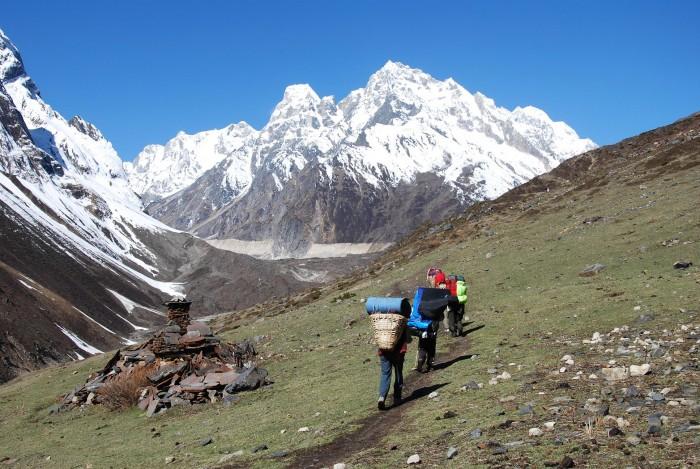
After enjoying the views from Larkya La top, you'll start descending to your day's resting point, Bhimthang. As you descend, you'll descend steeply through the grassy moraine. You'll get to a small settlement of Larche after some trekking time. A little below from Larche, there are two different ways: one way leads to Bhimthang, and another leads you to Salphudanda Glacier and Ponker Tal. You must follow your guide to stay on course. Once you get lost, you won't be able to get to Bhimthang. Yet if you follow your guide, you'll reach Tanbuche Kharcha and arrive at the day's destination, Bhimthang.
Walking distance from Dharmashala to Bhimthang
The distance from Dharmashala to Bhimtang via Larkya La Pass is approximately 14 km (8.9 miles). Trekking duration varies based on walking pace and trail conditions. Because the trekking routes pass through glaciers, there will be significant snow along the way during the winter season. Generally, it takes about 8-9 hours to reach Bhimthang from Dharmashala.
The trek to the top of Larke La Pass takes 4 hours, and from the pass, it takes 3 to 4 hours to reach Bhimthang. Over 8-9 hours, each step takes you along beautiful paths, offering views of snow-capped mountains and glaciers. However, the trail turns back as it ascends the mountain, so you should follow the iron pole for physical support and your guide for mental support.
Views from the top of Larkya La
As trekkers reach the top of Larkya La, the awe-inspiring views of the surrounding mountains will greet them. The panoramic views of Mount Manaslu (8,163 m/ 26,781 ft), Himlung (7,126m/23,379ft), and Annapurna (8,091 m/ 26,545 ft) are eye-catching from the top of Larkya La. Additionally, Kang Guru (6,981 m/22,904 ft), Ganesh Himal (7,422 m/24,350 ft), Cheo Himal (6820 m / 22375 ft), Annapurna II (7,937 m /26,040 ft), and Gyaji Kung (7,030 m/23064ft) are also spectacular from the Larkya pass.
Besides the snow-capped mountains, you can enjoy the stunning views of the small town of the Manaslu Circuit. However, views of the valley are not possible from the top of Larkya La; trekkers need to descend for half an hour and take a moment to appreciate the scenery of the surrounding villages, along with views of glaciers and lakes.
Glacier and Lakes
The stunning natural features of glaciers and lakes make the entire trek from Dharmashala to Bhimtnag appreciable. Trekkers can see two different lakes until reaching the top of Larkya La. Another lake, Dudh Kunda, lies on the horizon. A rocky, icy glacier is also the best view of Bhinthang via Larkya Pass.
One notable glacier on the journey is the Larkya Glacier. To reach the top of the Larke, trekkers need to walk over the cliff of the Glacier of the Larke. Furthermore, the beauty of the Salpudanda and Bhimdang Glaciers motivates trekkers to continue trekking while enjoying the views.
Day's difficulty
The trek from Dharmashala to Bhimthang is moderate to challenging. Because the trail passes through the highest pass on the Manaslu Circuit trek, it is relatively adventurous. From Dharmashala to the Larkya La top, the trek is adventurous, passing through rocky terrain along the Larkya Glacier. As you descend from the top of Larke Pass, the descent journey is less challenging than the ascent.
As trekkers reach elevations above 5000 m, altitude sickness is the primary concern. Altitude-related issues make the ninth-day Manalsu trek challenging. Unpredictable weather conditions also increase the difficulty of trekking from Dharmashala to Bhimthang via Larkya La Pass. Furthermore, the long trek distance tires trekkers and makes the trek more challenging, although we'll take breaks at certain points.
Although we can't make the trail easy, we do our best to provide proper acclimatization throughout the journey. Boundless Adventure prioritizes trekkers' safety. Throughout the trip, our team helps you stay comfortable so you can complete the trek with less difficulty and worry and more enjoyment.
Guide and Porters
Whether you are an experienced or a first-time trekker, we recommend hiring a guide and porter for the Manaslu Circuit trek. Because the Manaslu Circuit trek is in a restricted area, it is only possible with a licensed guide and a minimum of two people per group. While hiring a guide is mandatory, you may choose to hire a porter. However, hiring a guide for the challenging trekking, including the Larkya La Pass, is best. A porter carries all your equipment, and you'll be free from any burden, so you can only focus on the trip.
Boundless Adventure believes the trekking experience is only as good as the friendly, supportive team. We provide a delicate and brilliant guide and porter service for the Manaslu Circuit Trek. Our guides and porters are experienced and knowledgeable, and ensure your safety and an enjoyable trek throughout the journey. Our guides and porters are dedicated to their work and ready to make your journey on the Manaslu Circuit unforgettable.
Headlamp
The ninth-day trek begins early, at 3 am. Trekkers should carry a headlamp. Routes are not visible in the morning, so carrying a headlamp is crucial when trekking from Dharmashala to Larkya La Pass. Trekkers are more likely to be injured in the dark, so a headlamp helps keep them safe. Each trekker should wear a headlamp.
Get to Bhimthang
Getting to Bhimthang involves many exciting and adventurous journeys. You'll feel relaxed upon reaching Bhimthang at the end of the day. Trekkers find peaceful comfort in Bhimthang, surrounded by magnificent Himalayan scenery. The journey to Bhimthang takes 8-9 hours, passing through Larkya La Pass and the small towns of Larche and Tanbuche Kharka.
Bhimthang is a beautiful settlement in the Manaslu region at 3720m (12,204 ft) above sea level. It is on a considerable meadow ground alongside the river, surrounded by a melting glacier. In the surrounding area, there is also a beautiful Gurung settlement.
Bhimthang is known for its peaceful atmosphere and stunning natural surroundings. Some trekkers spend two nights in Bhimtang to enjoy the village views and get an extra day of rest. Majestic peaks, dense forests, and alpine meadows surround Bhimthang, providing trekkers with a peaceful, beautiful place to rest and recover after a strenuous day of trekking, making it a popular stop.
Altitude Gain and Loss
Throughout the trek from Dharmashala to Bhimthang, trekkers gain altitude and lose it at some point. Your journey begins in Dharmashala at 4,470 m / 14,665 ft. Then, the trekkers ascend towards Larkya La, gaining altitude. At 5106m/16751ft, Larkya La offers trekkers a 636m/2086ft elevation gain from Dharmashala to Larkya Top. Trekkers must ascend slowly and monitor their bodies while hiking to Larkya Pass from Dharmashaala. Staying hydrated and properly acclimatizing is necessary.
As trekkers pass Larkya, they'll start descending towards Bhimthang. As they descend from Larkya La, they'll start losing altitude. On the descent, trekkers pass Larcha and Tanbuche Kharka before reaching Bhimthang. At each point, trekkers lose altitude before reaching Bhimtang at 3,720 m (12,204 ft). The altitude difference trekkers lose while descending to Bhimthang is 1,386 m (4,547 ft). Trekkers must descend slowly due to the steep trail, which causes ankle pain.
Altitude gain and loss pose challenges during the trek; on the same day, trekkers gain 636m in elevation and lose 1386 m. So, the trekker should listen to their body throughout the journey. Additionally, proper acclimatization is necessary to allow your body to adapt to the new environment and ensure a safe, comfortable trek.
Accommodations
Although Bhimthang lies in a remote location, you'll find fine accommodation in Bhimthang. Trekkers can stay in local and fine hotels, where they can enjoy delicious meals and experience the region's lifestyle and culture.
At Bhimthang, trekkers get a unique opportunity to stay at elegant hotels. The hotels offer simple, comfortable rooms with twin beds. The Hotel's people serve meals in communal sunny dining areas. Trekkers can choose between local dishes and international cuisine. However, we recommend that trekkers try the local cuisine, which is tasty and hygienic. The local dishes offered by hotels in Bhimthang are nutritious and hygienic, as they are sourced directly from the farm and cooked on-site. Furthermore, you'll have beverage options. Accommodation in Bhimthang is more comfortable and better than the tea houses on the other side of the Manaslu Conservation Area.