


Day 6 is your resting day, known as Samagaon Acclimatization Day. What is acculturation? Acclimatization is the adaptation to the surrounding environment, including its temperature, humidity, altitude, and the presence of certain chemicals.
In the context of Trekking, Acclimatization is similar to adapting to the surrounding climate. As you reach Samagaon, the upcoming environment will be vastly different. Samagaon is at an elevation of 3,530 meters above sea level. Samagaon is a suitable point for Acclimatization, as you'll ascend to a higher altitude from Samagaon in the upcoming days during the Manaslu Circuit Lodge Trekking.
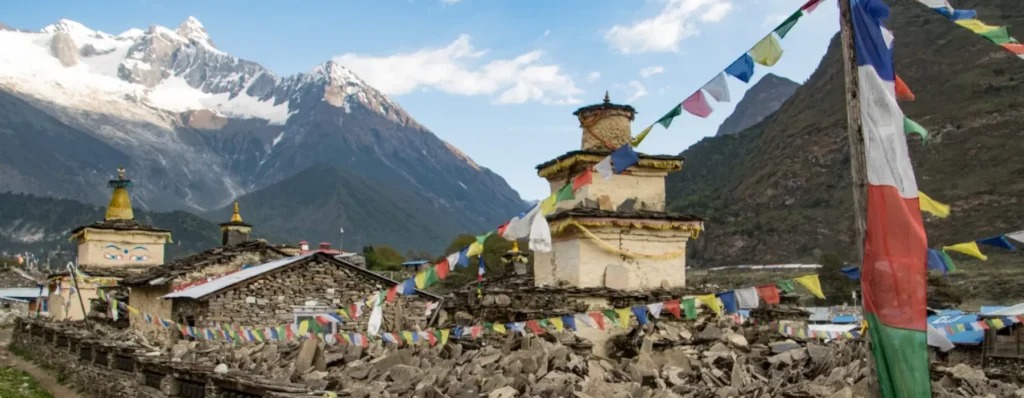
After waking up and having a sound sleep at the lodge in Samagaon, you will have a warm breakfast. You will rest for several minutes after having breakfast. Then, you will take a side trip to adapt to the surrounding altitude. There are several options for using the acclimatization day, including exploring Samagaon and its culture, or taking a side trip to either Manaslu Base Camp or Birendra Lake.
Samagaon and the surrounding culture:
Samagaon is a village in the Gorkha district, 3,530 meters above sea level, at the foot of Manaslu, under the Manaslu Conservation Area. It is a village development committee. The trail to the Manaslu Circuit lies through the village of Samagaon, the best place to rest during the trek. Samagaon provides a stunning view of Mt. Manaslu, which blesses your eyes.
According to the 1991 Nepal Census, the total population of Samagaon is 665, with 179 households. You must be curious about why there was no census information before 1991. The reason is that, before 1991, authorities restricted access to all villages above Jagat, and no one was allowed to explore the area. However, in 1991, the authorities granted permission to explore the restricted area by issuing a special permit.
To explore the Manaslu Circuit, one must obtain a special restricted area permit. Other restricted areas include the Tsum Valley Trek, Upper Mustang Trek, and Kanchenjunga Trek. The trustworthy trekking agency Boundless Adventure can provide a special permit for these areas.
The inhabitants of Samagaon are Tibetan Buddhists. There is a belief that they are migrants from Tibet who later settled in a village in Nepal. The inhabitants of Samagaon follow Buddhism, and many Buddhist pilgrimage sites are in the Manalsu Circuit, including Mane Monastery and Chorten.
One of the famous monasteries of Samagaon is Punggen Monastery (Gumba). Punggen Gumba is a holy place situated at an altitude of 4050 meters above sea level. Various-sized rocks and the Titanic Mountains surround the massive grassy area at the end of the area.
Punggen Monastery lies at the foot of Mt. Manaslu, offering spectacular views. It is an austere monastery with several dormitories for the monks. The monks are responsible for daily activities, including morning prayer and chanting. You can explore the monastery's cultural activities, as the monks living there are friendly and hospitable.
Buddha Purnima is the main festival of the inhabitants and the special day on which Lord Gautama Buddha was born in Nepal. People celebrate Buddha Purnima as a joyful occasion, the day on which Lord Buddha was born and attained Nirvana. The inhabitants of Samagaon also celebrate another festival, Lhosar.
Birendra Lake: Explore the Samagaon Acclimatization
Birendra Lake is a renowned lake located on the Manaslu Glacier at 3450 meters above sea level. To reach it, you have to ascend from Samagaon Village. It will take 45 minutes to reach Birendra Lake, spread over three squares.
On your way to Birendra Lake, you will also see the Statue of Rimpoche, the Second Buddha. Guru Rimpoche is a form of the Buddha who teaches the path to enlightenment, with an emphasis on Tantras. Guru Rimpoche, also known as Guru Padmasambhava, is one of the founders of Tibetan Buddhism. You can catch a glimpse of the statue of Guru Rimpoche on your way to Birendra Lake.
Birendra Lake is a perfect viewpoint offering mesmerizing views of the surrounding landscape. From the lake, you can see the stunning scenery of the snow-capped mountains and
Glaciers, including Mount Manaslu, Punggen Glacier, and Yamnag Glacier. Several hills slope toward Birendra Lake, and the surrounding stony ground is strewn with many stones.
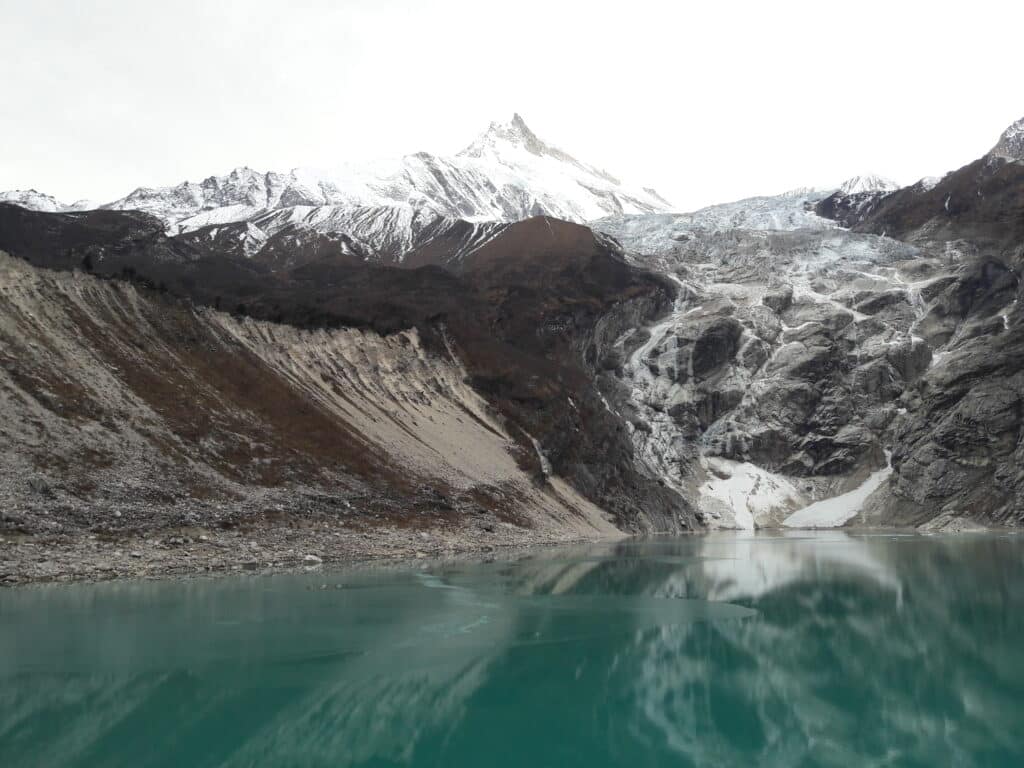
The water inside the lake is fresh and blue. On the bank of the lake, you will find a symbol of good luck made by visitors through several rocks, big, medium, and small. The construction involves placing large stones at the bottom, medium stones in the middle, and small rocks at the top.
You will be amazed by the beauty of Birendra Lake, which is clean and clear. Especially on a sunny day, you can see the lake's fascinating reflections of the sun, the surrounding hills, and the snow-capped mountains.
Hiking to Manaslu Base Camp:
Manaslu Base Camp lies at 4400 meters above sea level. It is east of Birendra Lake. The glaciers, including Manaslu Glacier, Syacha Glacier, and Yamnang Glacier, surround Manaslu Base Camp. You can have a spell-binding view of the snow-capped mountain, Mt. Manaslu, from the Manaslu Base Camp. Mt. Manaslu, known as the Manaslu Himal, is 8163 Meters above
sea level.
Mt. Manaslu is the world's eighth-highest mountain. The Manaslu Base Camp trek passes through a remote area far from modern influences, offering travelers a sense of inner peace.
Nepal is a well-known destination for tours and Trekking. One of the most famous trekking areas is the Everest region, where the world's highest mountain, Mt. Everest, lies. The trek to Everest Base Camp is very crowded, as people from around the world come to enjoy the beautiful scenery of Mt. Everest and the region's mesmerizing natural beauty.
Manaslu Base Camp is well known for helping you discover yourself during the trek. Why do people take a vacation, or why do people want a break from day-to-day life? Of course, it is because daily life sometimes feels like a burden. At some point in life, people feel exhausted doing the same thing repeatedly and dealing with the same people daily.
You surely want a break from the chaos of life to immerse yourself in nature and your surroundings, because nature heals and gives us spiritual and mental energy. Similarly, although the trek to the Everest region is renowned worldwide, people also visit Mt. Manaslu for its less crowded, more peaceful trails.
High-Altitude Sickness
What is the cause of high altitude sickness? High-altitude sickness is caused by rapidly ascending to a higher elevation without allowing your body to adjust to the surrounding environment, which reduces oxygen and changes air pressure. Lowering the oxygen level in the air and blood causes high-altitude sickness.
As mountain climbers rapidly ascend to higher elevations, they will likely experience high-altitude sickness. Usually, when trekkers hike above 3000 feet without Acclimatization, they are at a higher risk of developing high-altitude sickness. There are three stages of high-altitude sickness, including acute mountain sickness (AMS), high-altitude cerebral edema (HACE), and high-altitude pulmonary edema (HAPE).
High-Altitude Symptoms:
- Headache
- Cough
- Trouble Breathing
- Racing Heart
- Dizziness and Weakness
- Vomiting
- Insomnia
- Reduced Performance and Co-ordination
- Loss of appetite
- Feeling exhausted
How do you care for high-altitude sickness?
Some of the measures to cure High-Altitude Sickness are as follows:
- Stop your journey and acclimate
- Descend in case of High-Altitude sickness worsening
- Medication Pills, including acetazolamide, dexamethasone, and nifedipine.
Preventive Measure
One of the most effective methods to avoid high-altitude sickness is Acclimatization. Acclimatization helps your body adapt to the surrounding temperature, balancing your core temperature with the environment. Other measures to prevent high-altitude sickness during mountain climbing include Trekking and hiking in the Manaslu Conservation Area.
- Consult your doctor if you have any heart or lung conditions.
- Involve yourself in physical activities, including Aerobic training.
- Practice Yoga breathing rhythms.
- Make a habit of drinking large amounts of water.
- During the trek, slowly ascend to higher altitudes to help your body adapt to the surrounding environment.