


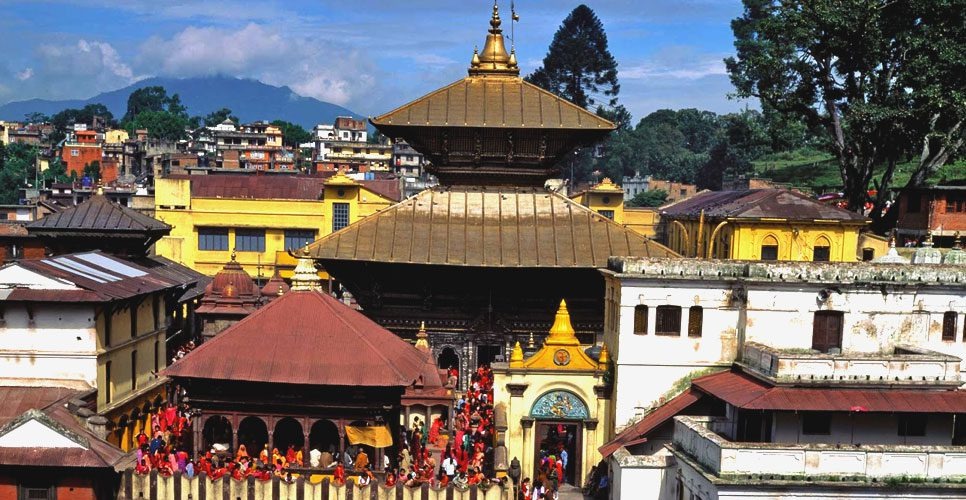
One of the oldest Hindu Pilgrimage sites, Pashupatinath Temple, is of great spiritual significance. Situated near the Bagmati River, it is believed to be the home of Lord Shiva. It is a Hindu temple; Pashupati means "guardian of animals" and refers to a form of Lord Shiva. The temple is located on a 246-hectare site and has been a World Heritage Site since 1979.
The temple's area is covered with 518 small temples, one of which is the main temple, with four entrance doors, silver-coated and gold-covered at the top of the roof. The Pashupatinath temple is built in the Pagoda style. Inside the main temple of Pashupatinath, there is a four-faced Shiva Lingam, an avatar of Shiva.
The Shiva Lingam is believed to have five faces, one of which is invisible. Devotees think that even at one time in your life, if you step foot on Pashupatinath and go inside the door and look at the four-faced avatar of Shiva, you'll go directly to heaven. Furthermore, it is regarded as accurate that the virtue of visiting is the same as going to the Kedarnath Temple.
History of Pashupatinath Temple
However, the year of the temple's construction is not precisely known; it is said to have been built by the Licchavi King Prachanda Dev, during the Licchavi dynasty's rule in Nepal. Although Pashupatinath is attested as early as 400 CE, the temple's present form dates to 1692 CE.
The exact history of Pashupatinath is unknown, but we believe in one mythological tale: on the east side of the Bagmati River, Lord Shiva and Goddess Parvati made the appearance of deer in the forest. Later, other gods learned of their appearance by taking the form of a deer and forcing Lord Shiva to assume his actual form, manifesting as a deer's horn.
The one-horned deer was broken and worshipped as the Linga of Shiva, but as time passed, the horn vanished. After centuries, one cow always came and swept its milk on the land; the herdsman dug where the cow always swept its milk and found that the linga of Lord Shiva had vanished. Later, the Pashupatinath Temple was built and remains regarded as one of the world's most significant Hindu temples.
Cultural and Religious Significance of Pashupatinath
Pashupatinath is the holiest Hindu temple, with cultural and religious significance for pilgrims from Nepal and India who seek blessings and connect with the divine presence of Lord Shiva. The Pashupatinath serves as a site for various religious and cultural practices. Rituals, prayers, and ceremonies are daily activities conducted within the temple premises.
The temple is a physical structure and a sacred site, significant for its role in connecting Spirituality, culture, and history.
8 Auspicious Symbols of Pashupatinath
The eight auspicious symbols, the "Ashtamangala" in Sanskrit, symbolize good fortune and spiritual significance. Eight auspicious symbols are also appreciated in Buddhism, except by Hindus. The Ashtamangala plays a vital role in environmental purification. The eight auspicious symbols of Pashupatinath are:
- Conch Shell (Shankha): The conch shell symbolizes the primordial sound and is associated with God. At Pashupatinath, it calls for prayers and declares the temple's sanctity.
- Dharma Wheel (Dharma Chakra): The Dharma Chakra symbolizes the human life cycle, birth, death, and rebirth. At Pashupatinath, it represents how life and Spirituality continually repeat and how people undertake a spiritual journey there.
- Lotus Flower ( Padma): Even though the lotus flower grows in mud, it is still beautiful. It symbolizes purity and spiritual enlightenment. At Pashupatinath, it symbolizes the growth of spiritual awareness amid life's challenges.
- Parasol (Chatra): The parasol represents protection and the umbrella of spiritual power. In Pashupatinath, it serves as a shelter and guide for people on their spiritual journey.
- The Endless Knot (Shrivasta): The endless knot symbolizes the interconnection of all phenomena and their eternal, continuous existence. At Pashupatinath, it represents the connection between devotees and the divine, as well as among devotees.
- Golden Fish (Matsya): The golden fish signifies fertility, happiness, and prosperity. In Pashupatinath, the golden fish symbolizes spiritual wealth and success achieved through a dedicated, virtuous life.
- The Banner of Victory (Dhvaja): It signifies the potential to overcome challenges and reach enlightenment, happiness, success, intelligence, and power. At Pashupatinath, it means God's awakening and devotees' ability to overcome every obstacle.
- Treasure Vase (Kalasha): The treasure vase is associated with the potential to gain greater wisdom, knowledge, peace, happiness, and power. In Pashupatinath, it is often said that many blessings and divine grace emanate from the sacred temple.
Daily Rituals and Activities at Pashupatinath
- Every day at 4 am, the west gate of Pashupatinath Temple opens for worshippers.
- Pujaris arrived around 8:30 am, began cleaning and bathing the lord, and changed the lord's jewelry and clothes.
- At 9:30 am, Bal Bhog (breakfast) is offered to the deity.
- From 10 am to 1:45 pm, Abhisheka is complete, and all four doors are open. At that time, individuals seeking a particular worship (puja) called the pujari to perform it. At Abhisheka, God's four faces are bathed in milk, yogurt, rose water, honey, ghee, and pure items.
- At 1:50 pm, in the main temple of Pashupatinath, lunch is offered to the God.
- At 2:00 pm, the morning worship ends.
- From 5:15 am, Aarati (flame worship) is done at the main Pashupati Temple.
- At 6:00 pm, the aarti at Bagmati begins; the Bagmati aarti is popular among the public. Every day at the Bagmati aarti, also called Sandhya aarti, many people come to see and worship. The Sadhya aarti is performed at the riverbank, and the Shiva tandav and other devotional songs dedicated to Lord Shiva are performed. In addition to Kathmandu residents, many tourists attended Sandhya Aarati and appreciated the night-flame workshop.
- The door will be closed at 9:00 pm, and the same activities will be repeated each day, except on special days. On some special days, the daily route may change.
In addition to the above activities, many visitors find peace through meditation at Pashupatinath. Although meditation is practiced throughout the temple premises, it is primarily conducted at the rear of the main Pashupatinath and along the banks of the Bagmati River.
Major Celebrations in Pashupatinath Temple
At every festival celebrated in Nepal, the Pashupatinath is a focal point for worship. During every festival, the temple will be full of devotees. Some of the grandest festival celebrations at Pashupatinath are:
- Teej: Teej is a Hindu festival dedicated to Lord Shiva's consort, Parvati, so the focal point of worship is Pashupatinath. On the day of Teej, women typically wear red garments, especially sarees, with some makeup. Both married and unmarried women celebrate Teej. There is a belief that if you fast and worship lord Shiva and Parvati on Teej, you'll get a good spouse if you are unmarried and blessed by Lord Shiva. If you are married, your marital bond will endure until your death and the prosperity of your family. On the day of Teej, the road of the Pashupati area will be full of women engaging in a long day fast to get a blessing from lord Shiva.
- Maha Shivaratri: Maha Shivaratri is the grand festival celebrated in the Pashupati Temple. Mahashivaratri is the night of lord Shiva. It is believed that Lord Shiva performs the Tandav on the night of Shivaratri. On the day of Manahashivaratri, every Hindu worships Lord Shiva. On the day, large numbers of Sadhus are seen at Pashupatinath smoking weed, as weed is said to be the Prasad of Lord Shiva. During Shivaratri, not only women but also men fast to impress lord Shiva. Due to the large number of worshipers, there would be little space to enter the Pashupati area. The area will be bustling at night, as devotees will be seen praying, meditating, and engaging in various activities. More than 1.5 million people visit Pashupatinath during this grand festival. Many people also visit the world's tallest statue of Lord Shiva (144 ft.), located at Sanga.
Major Attractions of the Area:
Besides Pashupatinath Temple, the Pashupatinath area has some lovely and peaceful places, some of which are:
- Guhyeshwori Temple: When Sati Devi died, lord shiva took her dead body and carried it around the world. At that time, her body's different parts fell in other places. The two knees of the Satidevi are on the site of the Guhyeshwari temple, located 1 km east of the Temple premises. The temple is not very attractive from the outside, but inside it is decorated with flowers. Because Satidevi's knees are on the Guheshwori site, the place is said to have a presence of 'Adisakti'. The Guhyeshwari temple is a prominent hub for marriage ceremonies and tantric rituals.
- Gorakhnath Temple: The stairs are visible from the opposite side of Pashupatinath. After walking up the stairs, you'll see the Gorakhnath temple at the top of the hill. The Gorakhnath temple is dedicated to Guru Gorakhnath, a yogi and saint. Although the temple's door is usually closed, you can get Sadhus worshiping there. Other small chaityas and shrines are also there for exploring around Gorakhnath.
- Aarya Ghats: From the opposite viewpoint of the Pashupatinath Temple, one can see people on the riverbank mourning the deaths of their relatives and loved ones. Aarya Ghat is a place where Hindu people fulfill their funeral rites and cremate the dead body as per Hindu rituals. Although Pashupatinath is peaceful, viewing the Aarya Ghats and the burning of human bodies may cause unconsciousness if you are seeing it for the first time. Looking at the burning body, we feel the human body is nothing. Aarya Ghat is a site where we can observe the realities of human life. There are two ghats in Pashupati: Western and Eastern. It is believed in the Hindu culture that if your body is cremated in Pashupati Aryaghat, you'll be reborn as a human in the next life.
In addition to the above attractions, you can explore the Pashupatinath Conservation Site, which is located near the Gorakhnath Temple. Here, you can see deer and other animals.
Activities You can get involved in Pashupatinath:
- Exploration: The Pashupati area is large, covering 246 hectares. You may not be able to complete a visit to the entire area in one day, especially if you are new to the area. If you are non-Hindu, you can explore every area of Pashupati except the main temple. Every location has its own uniqueness and significance.
- Meditation: In a peaceful setting, one can engage in meditation. Pashupatinath is a quiet place for individuals to meditate and engage in self-discovery.
- Festival celebration: If you visit Pashupatinath during the festival, you can participate. Participating in the festival celebrations at Pashupatinath offers a unique cultural experience.
Things Allowed Inside the Pashupatinath Temple:
- You can get insights and witness the daily ceremonies held inside the temple.
- At certain times, you can get a blessing from the four-faced Shiva lingam through the four doors of Pashupatinath.
- You can see the Sandhya Aarati, which takes place on the riverbank every evening.
- You can explore the temples, monuments, and shrines of the area.
- You can participate in festival events, including Maha Shivaratri, Teej, and others.
Things that are not Allowed Inside the Pashupatinath Temple:
- If you are non-Hindu, you are not permitted to enter the main temple. Furthermore, you can visit and explore other parts and temples.
- Before stepping inside the main temple area, you cannot wear shoes or leather items.
- At the Pashupatinath Temple, speaking loudly, shouting, and engaging in activities that disturb others' peace are strictly prohibited.
- Photography inside the main temple is prohibited; if you are caught taking photos inside the main temple, you'll be fined, and your mobile may get seized.
- Wearing a modern and non-religious dress is not acceptable; you may not get permission to get inside if you dress openly.
- Bringing pets into the main temple is prohibited.
Tips for Tourists and Pilgrims
- Be aware of Monkeys: If you feel like giving something to monkeys or playing with them, don't do so. Monkeys may attack you anytime, so stay away from them. Please do not show your belongings in front of the monkeys; they can take your stuff.
- Obtain permission for an interview: If you plan to record video and ask participants questions, obtain their consent first. People will generally answer you with a smiley face, but not all will be the same. Before recording someone, consider seeking their approval first.
- Maintain Silence: You should remain silent inside the Pashupatinath main temple. Making noise and using loud voices may distract others.
- Be prepared for crowds: Due to the presence of religious sites and tourist destinations, Pashupatinath may be crowded; plan accordingly. Consider researching peak times or asking locals about possible crowds.
Cultural Exploration Around Kathmandu:
If you are willing to visit other sites, we have a day-long side trip that includes exploring the Bhaktapur area, Kathmandu Durbar Square, Chandragiri, and the Pashupatinath area.
- Bhaktapur Exploration: Bhaktapur is a must-visit destination near Kathmandu Valley, providing a unique combination of cultural richness, historical significance, and authentic experiences. Bhaktapur Durbar Square is the major attraction. Tasting local Newari cuisine is another unique experience you'll get on the Bhaktapur exploration. Other exciting parts are connecting with the locals and learning about their culture.
- Kathmandu Durbar Square: Kathmandu Durbar Square is a UNESCO World Heritage Site in the heart of Kathmandu. The Kathmandu Durbar Square is a living museum of Nepalese history and culture, showcasing ancient temples and other historic sites. The Kumari Ghar and Taleju Temple are masterpieces that showcase Newari architecture. Exploration of Kathmandu Durbar Square allows you to taste local cuisine and the area's street food. Furthermore, Kathmandu Durbar Square is a must-visit destination showcasing Nepalese history.
- Chandragiri Temple: Located in the southeastern part of Kathmandu, on the Chandragiri Hills. Chandragiri Temple is another pilgrimage site where Bhaleshwor Mahadev is worshipped. The temple lies at the top of the mountain, providing a fantastic viewpoint. It is the best place that combines spiritual connection and natural beauty. The Chandragiri Temple is the most-visited destination in the Kathmandu Valley. The temple is located at an elevation of 2551m above sea level. As the temple is at the top of the hill, you must go by Cable Car. Hiking is also available, but if you are on a day trip, you must choose the Cable Car option.